
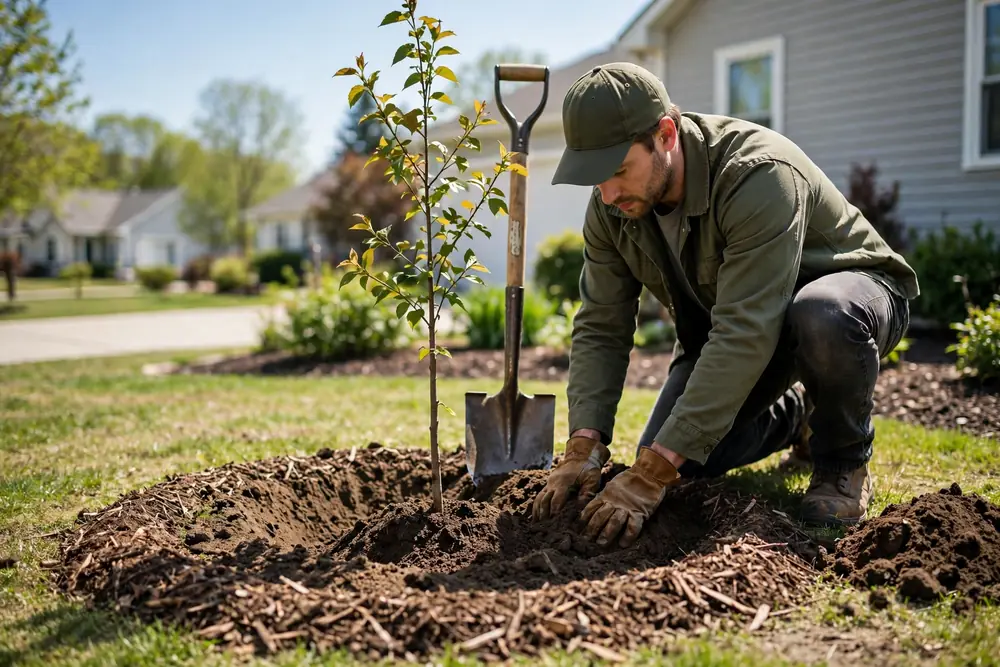
That dogwood was a great idea ten years ago. Now it is eating the walkway. Or the maple you love sits exactly where the new garage needs to go. Cutting it down feels wrong. Transplanting moves the whole tree — roots and all — to a better spot. We dig up the root ball, wrap it, transport the tree, and replant it where it can thrive. Then we give you a simple watering plan for its first year. It works best on younger trees. They bounce back fastest. Call or text (240) 213-4913 and we will give you an honest read on your tree's chances.
What Is Tree Transplanting?
Transplanting is moving a living tree from one place to another. Not a sapling from a nursery — an established tree already growing in your yard. We dig a wide circle around the trunk to capture the root ball: the mass of roots and soil the tree depends on. We wrap the ball in burlap to hold it together. Then we lift the tree, move it to its new hole, set it at the right depth, and water it in.
Size matters more than anything. A good rule of thumb: the root ball needs to be about a foot wide for every inch of trunk thickness. A 3-inch trunk needs a 3-foot ball. That ball, soil and all, can weigh several hundred pounds. Big trees need equipment. Small trees can move by hand with a strong crew.
Transplanting is not the same as planting a new tree. A nursery tree comes with a perfect root ball grown for moving. Your yard tree has roots spread everywhere, tangled with the soil. Moving it is surgery. Done right, the tree never knows it moved. Done wrong, it dies slowly over the next summer. The difference is the size of the root ball and the care in the move.
When You Need It
- A tree was planted too close to the house, driveway, or walkway.
- You are redoing the landscape and a good tree is in the way.
- Construction is starting and you want to save a tree first.
- A volunteer sapling popped up where you do not want it — but it is a nice tree.
- You bought a property and want to rearrange the yard around the trees you love.
- A tree is failing in its current spot — too much shade, too much water — and a better spot exists.
- A specimen tree (a dogwood, a Japanese maple, a redbud) deserves a showcase spot.
How It Works
- Free on-site visit. We check three things: the tree's size and health, the current spot, and the new spot. A healthy young tree in the dormant season is a great candidate. A stressed old tree in July is not. We give you an honest read before you spend a dollar.
- We plan the move. The new hole gets dug first — wider than the root ball, but no deeper. Planting too deep is the number one killer of transplanted trees. The root flare, where the trunk widens at the base, must sit at ground level. We also check the new spot's sun, drainage, and space. A tree moved from shade to blazing sun will struggle.
- You get a written price. It covers the digging, wrapping, transport, replanting, and the first deep watering. If the tree is big enough to need equipment, that is in the price too.
- We dig the root ball. We cut a clean circle around the tree, going deep enough to get under the main roots. Clean cuts heal. Ragged torn roots do not. The ball gets wrapped tight in burlap and tied so it holds together in the move. For larger trees, we may root-prune months ahead — cutting the outer roots in advance so the tree grows a dense, compact ball that survives the move.
- We move it with care. Small trees travel by hand and truck bed. Larger ones ride on equipment. The tree stays upright the whole way. The ball never gets dropped, rolled, or dragged by the trunk. Every jolt breaks roots inside the ball.
- We replant it right. The tree goes into the prepared hole at the exact right depth. We backfill with the native soil — not fancy mixes, which create a "pot" the roots never leave. We water it in deeply to settle the soil and remove air pockets. A flat ring of mulch goes around the base, kept back from the trunk.
- You get a simple aftercare plan. Water deeply and regularly through the first year. We give you a schedule based on the season and the tree. The first summer is the test. Follow the plan and your tree has the best possible start.
What Affects the Cost?
Four things drive the price of transplanting.
The size of the tree. This is everything. A 6-foot dogwood moves in an afternoon with hand tools. A 20-foot maple needs a bigger ball, more crew, and equipment to lift it. Bigger ball, bigger price.
How far it travels. Across the yard is one thing — we can sometimes move it in one continuous operation. Across town means loading, strapping, transport, and unloading. Distance adds time and equipment.
What equipment the job needs. Hand-dug moves are the most affordable. Larger trees may need a truck-mounted spade or a small excavator. We only bring equipment when the tree needs it, and we will tell you why.
The season. Dormant-season moves (late fall through early spring) are faster and safer. The tree is asleep and loses less water. Emergency summer moves are possible for small, healthy trees, but they need more aftercare and more of our time on site.
Call (240) 213-4913 for a free on-site written estimate. We will also tell you straight if your tree is a poor candidate — we would rather lose the job than watch a tree die.
Why Not Do It Yourself?
Moving a small sapling? Go for it. Dig wide, keep the roots wet, replant the same day. But anything bigger than a sapling gets hard fast.
First, the weight. Soil is heavy. A proper root ball for even a modest tree can weigh 300 to 500 pounds. People hurt their backs trying to muscle trees out of holes. A tree that tips and cracks its ball on the way out is a dead tree walking.
Second, the ball size. Homeowners almost always dig too small a ball. It feels like plenty. It is not. A skimped ball leaves half the roots behind, and the tree cannot drink enough water to survive summer. The rule — a foot of ball per inch of trunk — surprises most people.
Third, the depth mistake. Almost everyone plants too deep. It looks right. It feels safe. But a buried root flare rots, and the tree declines over years. You will not know you got it wrong until the tree is dying and it is too late to fix.
Fourth, the watering. A transplanted tree needs deep, regular water for a full year. Not a sprinkle — a soak. Most DIY moves fail here, in August, when the homeowner goes on vacation for a week. Our aftercare plan spells it out so the tree makes it. If the tree matters to you, call (240) 213-4913.
Common Tree Transplanting Mistakes
Mistake 1: Moving in summer heat. A tree moved in July is awake, thirsty, and losing water through every leaf — with half its roots left behind. Dormant-season moves (late fall to early spring) are dramatically safer. If you must move in summer, pick a small tree, move on a cool cloudy day, and water like your tree's life depends on it. Because it does.
Mistake 2: Digging too small a root ball. This is the number one DIY killer. The ball looks huge in the hole. It is still too small. Measure the trunk, multiply by a foot per inch, and dig that wide. When in doubt, go bigger. Roots you leave behind do not grow back in time.
Mistake 3: Planting too deep. The root flare — where the trunk widens at the base — belongs at ground level, not below it. Buried flares rot. Every year we see trees dying from this, years after the move. Set the tree a touch high; it will settle.
Mistake 4: Skipping the watering plan. The move is the exciting part. The year after is what decides. A transplanted tree needs deep watering through its first full growing season. "The rain will handle it" is how trees die in August. Set a schedule and stick to it — we give you one with every job.
Mistake 5: Moving a tree that is already stressed. A tree with dying branches, peeling bark, or a thin canopy is telling you it is struggling. Moving it adds the biggest stress of its life. Fix the health problem first, or accept that removal and a fresh planting may be the better call.
Our Service Area
Waldorf Tree Services Experts transplants trees across Waldorf, MD and all of Charles County — from La Plata and White Plains to Bryans Road and Accokeek. Whether the tree is moving across your yard or across the county, we will get it there alive. Check our tree service in La Plata and tree service in White Plains pages for nearby coverage.
Get a Free Estimate
Ready when you are. Call or text (240) 213-4913 — or send our short form and we will call you back. One call. Free visit. Written price. No pressure.
[Call (240) 213-4913 — tap to call: tel:+12402134913]
Free estimate form: Name | Phone | Service needed
Waldorf Tree Services Experts — we serve Waldorf, MD and all of Charles County.