
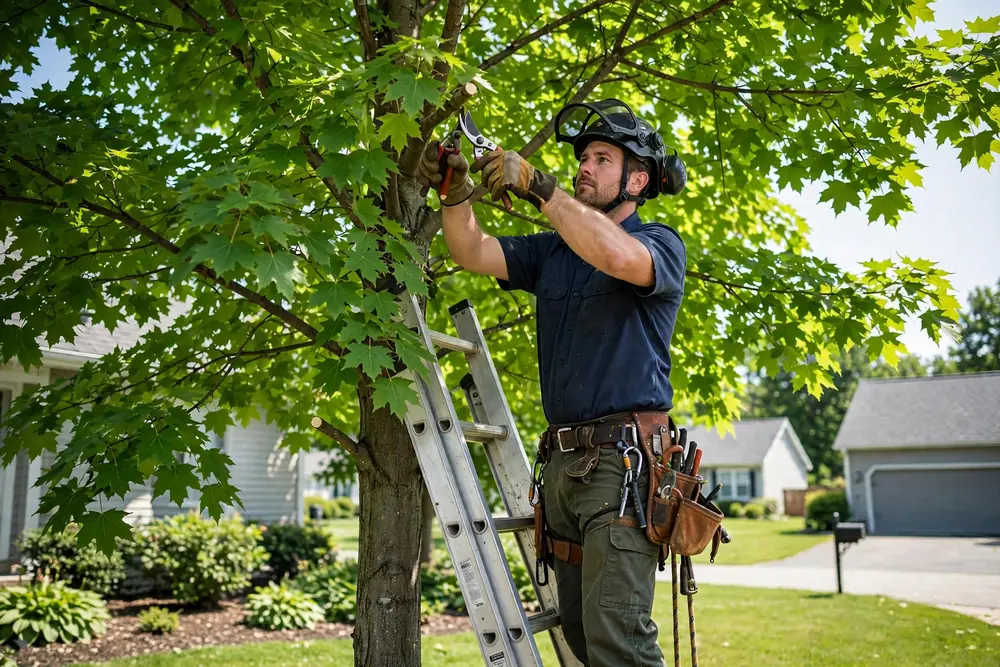
Some trees earn a second chance. The big oak that shades your whole backyard. The maple your kids grew up climbing. It has a cracked limb or a trunk splitting into a V — and you are stuck between "do nothing and hope" and "cut the whole thing down." Cabling and bracing are the middle path. We install steel supports that hold the weak spots together, so a good tree can stand safely for years. It often costs less than removal — and you keep the shade, the beauty, and the tree.
What Are Cabling and Bracing?
Cabling and bracing are structural supports for trees worth saving. Cabling runs strong steel cables high in the canopy, connecting a weak limb to stronger limbs or the trunk. The limbs share the load, so no single weak joint takes the full force of the next windstorm. Bracing drives threaded steel rods through a split trunk to pin the wood together and lock it solid. Many jobs need both: cables support the limbs above, rods hold the trunk below.
The hardware is made for trees. Cables attach with anchors that let the tree move and grow — the support works with the tree, not against it. Rods are cut flush and capped so the bark can grow around them. This is not rope tied around branches. It is engineered support, installed to industry standards, built to last for many years.
Cabling and bracing are not for every tree. The tree itself must be healthy enough to be worth saving — supports hold wood together, they do not cure rot or disease. That is why the first step is always an honest inspection. If the tree is a good candidate, supports can add years of safe life. If it is not, we tell you that too, and talk about tree removal instead.
When You Need It
- A large limb has a crack where it meets the trunk.
- The trunk splits into two leaders forming a tight V (a weak joint).
- You love the tree but worry it will split in the next storm.
- A heavy limb hangs over your roof, and you do not want to lose the tree.
- An old, valuable tree needs extra support to stay safe.
- A tree risk assessment flagged a weak spot but said the tree could be saved.
- You were quoted for removal and want to know if support is an option first.
How It Works
- Free on-site visit and candidacy check. We inspect the weak spot up close — the crack, the split, the wood around it. We check whether the tree is healthy enough for supports to work. Not every weak tree is a candidate, and we would rather tell you "no" than sell you hardware that will not hold.
- Written plan and price. You get a plain-words plan: how many cables, how many rods, where each one goes, and what it costs. You approve the full picture before any drilling starts.
- Cable installation. Climbing or a bucket truck is used to reach high in the canopy. We drill precise anchor points in strong wood, set the hardware, and run the steel cable between limbs with a tensioner that lets us set the support just right. The cable sits high, where leaves hide it most of the year.
- Brace rod installation. Where a trunk splits, we drill straight through the wood and set a threaded steel rod with washers and nuts on both sides. The rod pins the split together. We cut it flush so the tree can grow over the ends naturally.
- Weight reduction where it helps. Sometimes a supported limb still carries too much weight at its tip. A light, careful pruning of the ends takes the strain off the cable — support plus smart pruning works better than either alone. (See tree pruning for how we shape living wood.)
- Recheck schedule. We tell you when to have the hardware checked — usually every 2 to 3 years. Trees grow, and supports need a trained eye now and then to stay safe. We put the schedule in writing.
What Affects the Cost?
- Number of cables and rods. One cable on a single weak limb costs less than a full system with three cables and two brace rods across a split trunk.
- Tree height and access. A 25-foot maple reachable by bucket truck is simpler than a 60-foot oak that needs a full climb. Height and access drive the labor.
- Hardware type. Standard steel cable suits most jobs. Larger trees or heavier loads may need heavier-duty systems, which cost more.
- Follow-up inspections. The recheck visits every few years are part of owning a supported tree. We quote the installation up front and tell you what the inspections run.
Cabling usually costs less than removing a big tree — and you keep the tree. Every job is different, so we give a free on-site written estimate.
Why Not Do It Yourself?
This one is simple: do not. Drilling into a tree is surgery. Drill in the wrong place and you open a wound the tree cannot close — decay moves in, and you have made the weak spot worse. Set the wrong tension and the cable snaps in a storm, or slowly strangles the tree as it grows. Hardware-store rope and cable rust, stretch, and fail — tree supports need rated steel hardware and the knowledge to place it.
There is also the judgment call no DIYer should make alone: is this tree even a candidate? A support system on a rotting trunk gives you false confidence and a heavier falling limb. That is a professional call, made up close, by someone who has seen what holds and what fails. This is one job where hiring the pro is not about convenience — it is about safety.
Common Tree Cabling & Bracing Mistakes
Mistake 1: Cabling a tree that is too far gone. Supports hold sound wood together. They cannot fix a hollow trunk, advanced rot, or a tree that is already dying. Spending money on hardware for a doomed tree just delays the removal — at higher total cost. What to do instead: get an honest candidacy inspection first, and accept "no" as an answer.
Mistake 2: Installing supports and never checking them again. Trees grow. Bark thickens, limbs get heavier, hardware shifts. A cable that was perfect in 2023 can be wrong by 2027. What to do instead: put the 2-to-3-year recheck on your calendar like an oil change. We remind our customers when theirs is due.
Mistake 3: Hiring a handyman with rope. Rope rots, stretches, and saws through bark. A rope "cable" looks like support and acts like a slow injury. What to do instead: insist on proper steel cable and rod hardware, installed by a tree crew that does this work regularly.
Mistake 4: Choosing cabling to dodge a removal the tree truly needs. Sentiment is real — nobody wants to lose a beloved tree. But if the trunk is split through, the roots are failing, or the tree leans over your child's bedroom, supports are not the brave choice; removal is. What to do instead: ask us for the blunt read. We will tell you when support is smart and when it is not.
Our Service Area
We serve Waldorf, MD and all of Charles County — including La Plata, Port Tobacco, and Bryans Road. If a big tree you love has a weak spot anywhere in the county, we will come take a look for free.
Get a Free Estimate
Ready when you are. Call or text (240) 213-4913 — or send our short form and we will call you back.
[Call (240) 213-4913 — tap to call: tel:+12402134913]
Free estimate form: Name | Phone | Service needed
We serve Waldorf, MD and all of Charles County.