
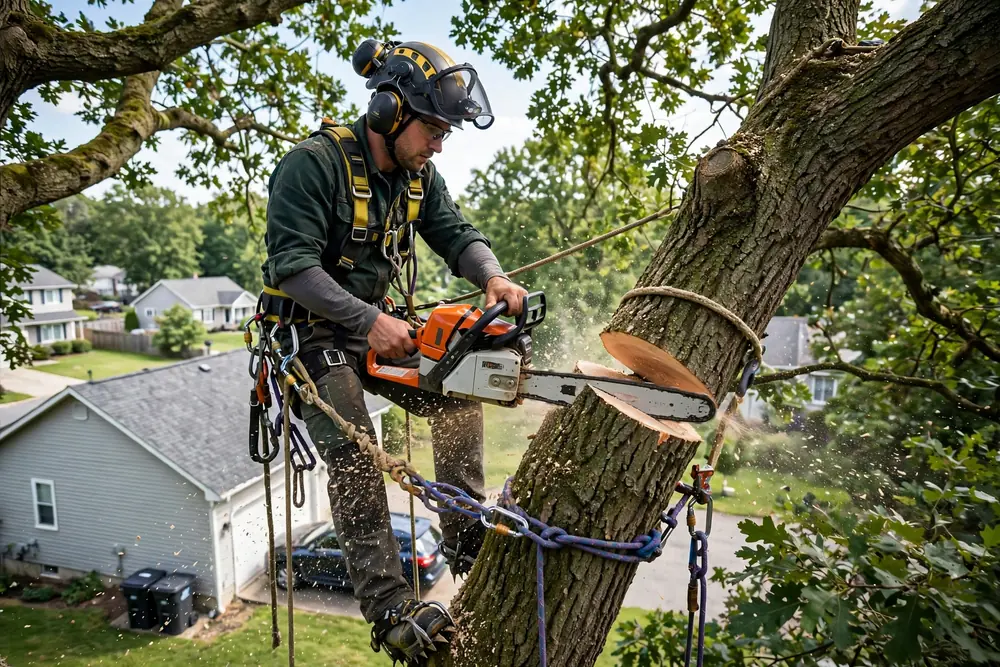
A dead or dying tree on your property is more than an eyesore. It is a risk. A full-size oak can weigh several tons. If it comes down the wrong way, it can crush a roof, smash a car, or tear through a fence. Here in Waldorf, nor'easters and summer storms knock down weak trees every year. You do not want to find out how weak yours is in the next storm. Trees are taken down safely, piece by piece, with ropes, rigging, and the right gear. Then the wood is hauled away and the work area is cleaned up. Call or text (240) 213-4913 today for a free on-site written estimate from Waldorf Tree Services Experts.
What Is Tree Removal?
We remove the whole tree — trunk, limbs, and all. First we study the tree. Which way does it lean? Where are the heaviest limbs? What sits near it — your house, a fence, power lines, a shed? Every answer shapes the plan.
For most trees in a yard, we take the tree down in sections. A trained climber goes up, or we use a lift for tall pines. Each limb and each chunk of trunk is tied with rope before it is cut. The ground crew lowers it slow and easy. Nothing drops onto your lawn, your roof, or your fence.
The brush goes through a wood chipper. The trunk is cut into logs and loaded on the truck. If the tree is small and the yard is open, we can sometimes fell the whole tree at once — but only when there is a clear, safe drop zone.
Our crew is licensed and insured, with over 10 years of experience. When the crew drives away, the tree is gone and the work area is raked.
Related: want the stump gone too? See our stump grinding page. Storm damage? See emergency tree service.
When You Need It
- The tree is dead or dying. No leaves in spring. Bark falling off in sheets.
- A nor'easter or summer storm split the trunk or ripped off big limbs.
- Roots are lifting your driveway, sidewalk, or patio stones.
- Roots are pushing on your foundation, and the cracks are growing.
- The tree leans toward your house, and every windy night keeps you up.
- A weak tree is crowding a healthy tree you want to keep.
- You need the space — for an addition, a pool, a shed, or a new fence line.
If one of these sounds like your yard, call (240) 213-4913. We will come look and give you a straight answer. Sometimes pruning can save a tree, and we will tell you when that is true.
How It Works
- Free on-site visit. We look at the tree, your yard, and everything near it. You get a written price. No guesswork.
- We plan the job. Every tree is different. We check the lean, the dead spots, and the obstacles. We pick the drop zone or the rigging points. For tight yards between houses, we rig every single piece — nothing free-falls.
- We set up the site. The truck and chipper park where they can reach the tree with the least driving on your lawn. Mats are laid down to protect garden beds and soft spots when needed. Ropes and saws are checked before anyone climbs.
- We take the tree down in sections. The climber ties off each limb, cuts it, and the ground crew lowers it with rope. Big limbs come down slow. The trunk is cut into rounds as we work our way down. The ground crew feeds brush into the chipper as we go, so the yard never turns into a mess.
- We deal with the stump. Most homeowners have us grind the stump on the same visit. It costs less together than as two trips, and you get a clean yard in one day. (See our stump grinding page for how that works.)
- We clean up. Chips are hauled away unless you want them for mulch. Logs are loaded out. The whole work area is raked. Then we walk the yard with you so you can see it is done right.
What Affects the Cost?
Size of the tree. A small dogwood takes about an hour. A 60-foot oak takes a full day with a crew. More wood means more sections, more time, and more hauling.
Access. Can our truck and chipper get close to the tree? Or is it behind a fence with a narrow gate? Tight access means more hand-carry work, and that takes longer.
Condition and risk. Dead trees are brittle and unpredictable. They need extra care. A tree leaning hard over your roof needs more rigging than a straight tree in an open yard. More risk means more setup time.
Extras. Stump grinding, cutting logs to firewood length, and extra hauling each add a bit. We list every option in your written price so you choose what you want.
Every job is different, and that is why the estimate is free and on-site. Call (240) 213-4913 and we will come look, price it in writing, and answer your questions.
Why Not Do It Yourself?
A tree is far heavier than it looks. A trunk section can weigh hundreds of pounds. If it falls the wrong way, it goes through a roof or a fence — or worse.
Chainsaws are the second risk. Kickback happens fast, and one bad cut can send the saw toward you. Ladders are the third. Cutting limbs while balanced on a ladder is how falls happen every year.
Then there is hidden rot. A tree can look solid outside and be hollow inside. When hollow wood breaks, it breaks in ways you did not plan.
And power lines are a hard no. Never cut near live lines. Call the utility company instead.
A trained crew has ropes, rigging, chippers, and insurance. What takes us a morning can take a homeowner a dangerous weekend.
Common Tree Removal Mistakes
Waiting too long on a dying tree. The mistake: hoping it stands one more year. Why it costs you: a dead tree gets weaker every month. A planned removal is far cheaper and safer than emergency cleanup after the storm brings it down. What to do instead: call for a free estimate when you first see the signs — no leaves in spring, bark falling off, big dead limbs.
Hiring on price alone. The mistake: taking the cheapest quote from a guy with a chainsaw and no insurance. Why it costs you: if he drops a limb through your fence — or gets hurt on your property — the problem lands on you. What to do instead: ask for proof of insurance and a written price before anyone starts work.
Skipping the cleanup question. The mistake: the quote covers cutting only. You come home to a mountain of brush. Why it costs you: you pay a second time to have it hauled. What to do instead: ask up front exactly what cleanup and hauling are included in the price.
Starting it yourself, then getting stuck. The mistake: cutting halfway and the tree gets wedged in another tree — a hung-up trunk looming over your yard. Why it costs you: now it is more dangerous and harder to finish. What to do instead: call us before you cut, not after.
Tree Removal Across Charles County
We serve Waldorf, MD and all of Charles County — including La Plata, White Plains, and Bryans Road. See our tree service in La Plata and tree service in St. Charles pages for those towns. One call covers it all: (240) 213-4913.
Get a Free Estimate
Ready when you are. A dead or dangerous tree does not get safer with time. Call or text (240) 213-4913 and we will come out, look at the tree, and give you a written price. No pressure, no games.
Or send our short form — Name | Phone | Service needed — and we will call you back.
[Call (240) 213-4913 — tap to call: tel:+12402134913]
We serve Waldorf, MD and all of Charles County.