
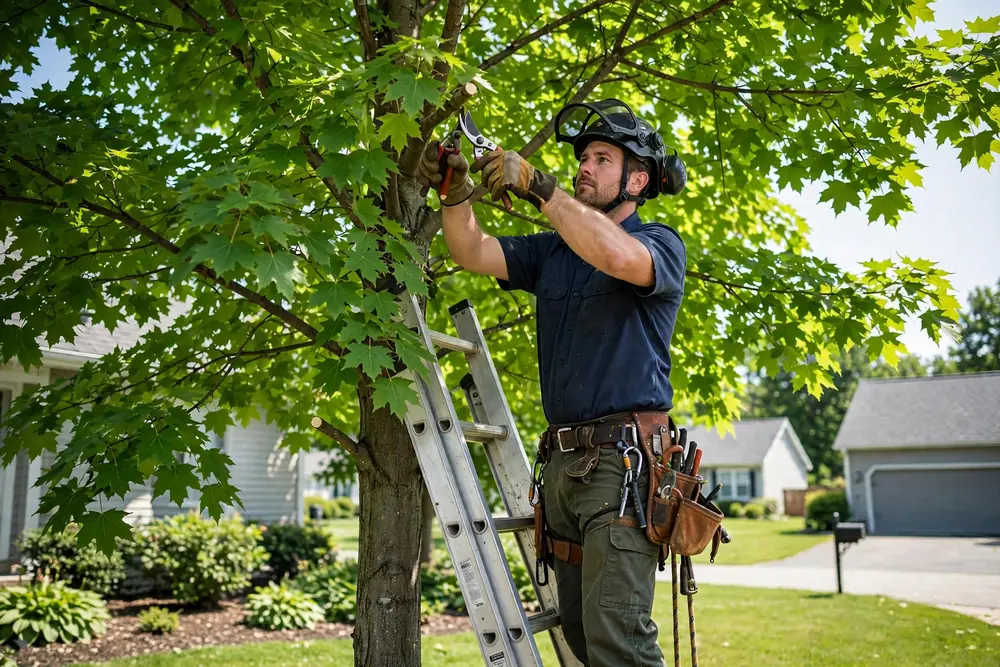
Your oak does not look right. The leaves came in thin this spring. The bark is peeling in a strange way. You are not a tree expert — you just know something is off.
That is exactly what a tree health inspection is for.
At Waldorf Tree Services Experts, we check your trees from roots to crown. We find what is wrong — disease, pests, weak structure, bad soil. Then we give you a plain-English plan: what to treat, what to prune, what to watch, and what can wait. Catching problems early is always cheaper than removing a dead tree later.
What Is a Tree Health Inspection?
A tree health inspection is a checkup for your trees. Think of it like a doctor's visit, but for oaks, maples, and pines.
We look at everything. The trunk: cracks, holes, soft spots, mushrooms at the base. The bark: peeling, cankers, oozing sores. The limbs: dead branches, weak joints, broken hangers. The leaves: spots, odd colors, early drop, thin crowns. Then we look down, not up — the roots and the soil. Wet clay soil, buried root flares, and construction damage cause more tree deaths in Charles County than most diseases.
After the inspection, we tell you what we found in plain words. No jargon. Then you get a written plan: what to treat, what to prune, what to watch, and what is fine. The plan is yours. You can have us do the work, or you can call us back later. There is no pressure.
Here is the key distinction. An inspection is DIAGNOSIS — finding the problem and writing the plan. Treatment is the WORK that follows — pruning, spraying, injections, soil care. Our Tree Disease Treatment page covers the treatment side. You would not take medicine before a diagnosis. Same idea here: inspect first, treat second.
(One more distinction: a health inspection is about the tree's health — disease, pests, vigor. If you need a formal hazard rating, say for an insurance question or a tree near a structure, our Tree Risk Assessment page covers that separately.)
We give you our honest read, based on over 10 years of experience. Some trees bounce back with treatment. Some are too far gone. We will not sell you treatment a tree does not need.
When You Need It
Trees cannot tell you they are sick. But they show it. Here are the signs to watch for.
- Leaves are yellow, spotted, or falling off way too early.
- Bark is peeling, cracked, has holes, or oozes sap.
- Branches are dying back from the tips, a little more each year.
- Mushrooms or fungus grow at the base of the trunk.
- The crown looks thin — you can see too much sky through it.
- The tree leans more than it used to, or the soil heaves up on one side.
- A neighbor's tree had disease, and you want yours checked before it spreads.
- You just bought a home and want to know if the big trees are safe.
That last one matters. Big old trees near a house deserve a yearly look. A small problem found in spring is a cheap fix. The same problem found after a limb falls is not.
How It Works
- Free on-site visit. Call (240) 213-4913 and tell us which trees worry you. We come out and inspect each one. Walk with us if you like — we will show you what we are seeing as we go.
- We check roots to crown. We start at the base: root flare, soil, mushrooms, cracks. Then the trunk: bark, cankers, holes, lean. Then the limbs and branches: deadwood, weak joints, hangers. Then the canopy: leaf color, leaf size, crown density. We also note the setting — wet spots, construction damage, crowded planting — because the site often explains the sickness.
- We explain what we find in plain words. No Latin names thrown at you without explanation. If your oak has bacterial leaf scorch, we tell you what that means in plain terms: what it does, how fast it moves, what it costs to manage. You will understand every word.
- You get a written plan. The plan lists each tree, what is wrong, and what to do: treat this one, prune that one, watch this one, remove that one because it is too far gone. Each item gets a price. You decide what to do and when.
- We can do the work — or you can wait. Most homeowners have us do the treatment or pruning while the plan is fresh. But there is no pressure. The plan is yours to keep. Call us back next month or next season and we will pick up where we left off.
What Affects the Cost?
Four things drive the price of a tree health inspection and the plan that follows.
How many trees. One worried oak is a quick visit. A full property walk with fifteen trees takes longer. We inspect what you ask about — one tree or the whole yard — and the time scales with the count.
How big and how old. Big, old trees take longer to inspect properly. There is more canopy to read, more bark to check, and the stakes are higher when a 60-foot oak leans toward your bedroom. Large specimen trees get the most thorough look.
How sick it looks. A tree with one spotted leaf is fast to assess. A tree with dieback, cankers, and mushrooms needs a deeper read — more time on site, and sometimes a follow-up visit to watch how fast things change.
What the plan includes. The inspection itself and the first visit are free. If the plan calls for treatment, pruning, or soil work, each item is priced separately on the written plan. You choose what to do. Nothing is bundled without your say-so.
Call (240) 213-4913 for a free on-site visit. We look, we explain, and you get a free written plan. No guesswork, no pressure.
Why Not Do It Yourself?
You can spot the obvious stuff yourself — yellow leaves, dead branches, mushrooms. And you should. Walking your yard twice a year and looking up is the best free tree care there is.
But diagnosis is harder than spotting. Yellow leaves can mean ten different things: disease, pests, bad soil, root damage, too much water, not enough water. Treating the wrong cause wastes money and lets the real problem grow. A pro narrows it down fast because they have seen each pattern hundreds of times.
There is also the climbing and the close look. Reading a canopy means getting eyes on the upper limbs. Most homeowners cannot safely do that. We have the tools and the training to inspect the whole tree, not just the bottom ten feet.
And the honest truth: DIY diagnosis usually ends at Google, and Google will tell you your tree has five diseases at once. An inspection gives you one answer and a plan. If you like watching your trees, keep watching — and call us when something looks off. That is the best of both.
Common Tree Inspection Mistakes
Waiting until the tree is half dead. The mistake: you notice thin leaves for two years and hope it gets better. Why it costs you: early disease is treatable; late disease means removal, which costs far more. What to do instead: call at the first sign. An inspection is free — there is no reason to wait.
Treating before diagnosing. The mistake: you buy a spray or a fertilizer and guess. Why it costs you: the wrong treatment wastes money and time while the real problem spreads — sometimes to your other trees. What to do instead: get the diagnosis first. Then treat the actual problem, once, correctly.
Only looking at the leaves. The mistake: the leaves look fine, so the tree must be fine. Why it costs you: root rot, trunk decay, and structural cracks hide below or inside. By the time the leaves show it, the problem is advanced. What to do instead: during our visit we check roots, trunk, and structure — the parts you cannot see from the lawn chair.
Ignoring the soil and the site. The mistake: treating the tree while the real cause sits in the ground — wet clay, buried root flare, construction damage. Why it costs you: the treatment fails because the cause is still there, and you pay twice. What to do instead: let the inspection include the site. We look at drainage, soil, and root conditions, and the plan fixes causes, not just symptoms.
Where We Work
We serve Waldorf, MD and all of Charles County. We inspect trees across St. Charles (/tree-service-st-charles-md/), La Plata (/tree-service-la-plata-md/), and every neighborhood in between. If a tree has you worried, call and we will come take a look.
Get a Free Estimate
Ready when you are. Call or text (240) 213-4913 — or send our short form and we will call you back.
[Call (240) 213-4913 — tap to call: tel:+12402134913]
Free estimate form: Name | Phone | Service needed
We serve Waldorf, MD and all of Charles County.