
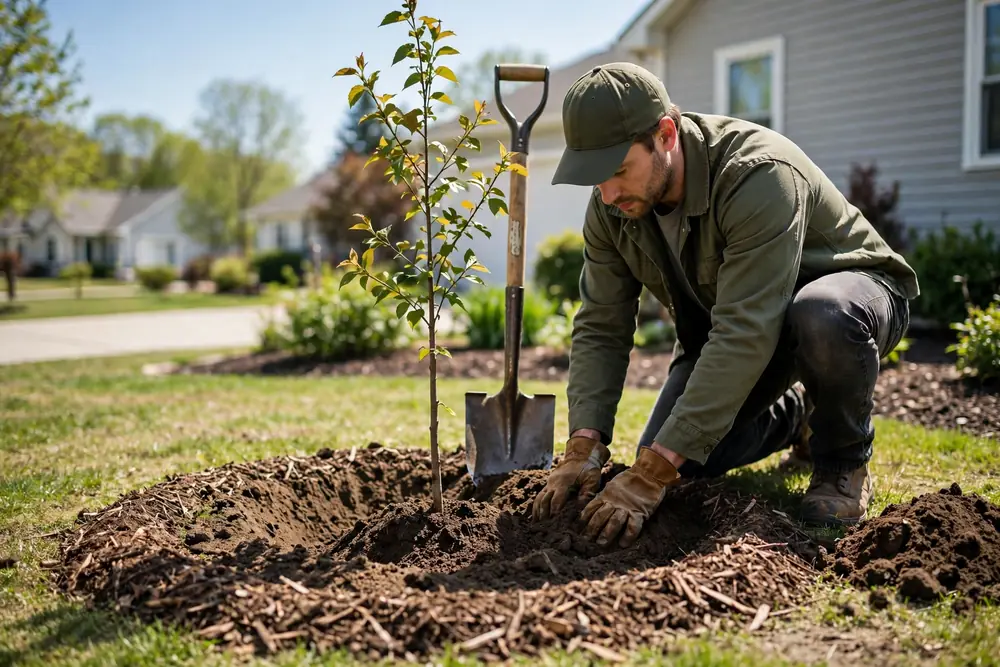
Your tree is telling you it is hungry. The leaves come in small and pale. Growth slows to almost nothing. Branches die back a little more each year. Trees in the forest feed themselves — fallen leaves rot into rich soil. But your yard tree competes with the lawn, sits in compacted clay, and lost its topsoil to construction years ago. Deep-root fertilization feeds the tree directly at its roots, where it actually drinks. The result: fuller leaves, stronger limbs, better color — and a tree tough enough to fight off disease and pests.
What Is Tree Fertilization?
Tree fertilization is feeding a tree the nutrients it is missing, delivered where the roots can use them. Our main method is deep-root injection: we drive a probe 8 to 12 inches into the soil and release a slow-release mix into the root zone, in a grid pattern under the tree's canopy. The mix feeds over weeks and months, not all at once. Nothing sits on your lawn. There is no mess, no smell, no granules for pets to find.
This is very different from tossing a bag of lawn fertilizer around the trunk. Lawn food is the wrong mix for trees — too much fast nitrogen, not enough of what trees actually need, like iron and manganese. In Maryland's clay soil, iron shortage is common and turns leaves yellow while the veins stay green. Too much nitrogen can even burn roots. Trees need a tree-specific mix, placed deep, released slow.
We also look at the soil itself, because food is only half the story. Compacted soil starves roots of air and water. Sometimes the right prescription is fertilization plus aeration and a proper mulch ring — food, air, and moisture working together. That combination is what turns a struggling tree around.
When You Need It
- Leaves come in small, pale, or yellow — especially yellow leaves with green veins.
- The tree grows slowly, or barely grows at all, year after year.
- Branches die back a little more each season.
- Construction, grading, or trenching disturbed the roots in recent years.
- A young tree needs a strong start in its new home.
- The tree looks stressed but has no clear pest or disease problem.
- You want your big shade trees fed before storm season hits.
How It Works
- Free on-site visit. We check the tree and the soil around it. We look at leaf color and size, growth rate, and how compacted the ground is. If we see signs of disease or pests instead of hunger, we say so — feeding a sick tree is not the fix.
- Written price and a custom mix. You get a clear quote based on the number and size of your trees. The nutrient mix is matched to your tree and your soil, not poured from one jug for every yard.
- Deep-root injection. We inject the slow-release mix 8 to 12 inches deep, in a grid pattern under the canopy — the drip line area where the feeding roots live. The probe holes are small and close up on their own. Your lawn is untouched, and there is nothing on the surface for kids or pets.
- Watering guidance. We tell you when and how much to water after treatment. Water helps carry the nutrients to the roots and wakes the feeding process up. Deep, slow watering beats a quick sprinkle.
- What to expect, honestly. Leaves usually green up within a few weeks. Fuller canopy and stronger growth show by the next growing season. If nothing changes, something else is wrong — and we will tell you what we see. Some trees join a yearly program; most just need a boost every few years.
What Affects the Cost?
- Number and size of trees. Feeding three small trees costs less than feeding a giant old oak. Bigger canopy, bigger root zone, more treatment.
- The method. Deep-root injection costs more than a surface application — and it works far better, because the food goes where the roots are instead of feeding your grass.
- Added soil care. If the soil is badly compacted, aeration or a mulch ring may join the prescription. These make the fertilizer work better, and we quote them together.
- One-time boost vs. yearly program. A single feeding suits most trees. Stressed or high-value trees may do better on a yearly plan, which costs less per visit than one-off calls.
Every yard is different, so we give a free on-site written estimate. You know the price — and the mix — before we start.
Why Not Do It Yourself?
Honest answer: a simple granular feeding on a small tree is DIY-able. But it is easy to get wrong. The wrong mix feeds the grass and starves the tree. Too much nitrogen burns roots. And Maryland's lawn fertilizer law limits when and how much fertilizer can go down — the rules exist to protect the Chesapeake Bay watershed, and they apply to your yard.
The bigger problem is that DIY cannot do deep-root injection. Surface granules sit on top of compacted clay while the real feeding roots sit 8 to 12 inches down. You end up feeding the lawn and wondering why the tree looks the same. For big, valuable trees, professional injection puts the right food at the right depth in one visit. If you do feed a small tree yourself, use a slow-release, tree-formulated product — never straight lawn fertilizer.
Common Tree Fertilization Mistakes
Mistake 1: Feeding a sick tree without a diagnosis. Yellow leaves can mean hunger — or disease, borers, or root rot. Fertilizing a diseased tree can actually feed the problem and delay the real fix. What to do instead: get the tree checked first. We tell you whether it needs food, treatment, or both — a tree health inspection answers this in one visit.
Mistake 2: Dumping lawn fertilizer around the trunk. Lawn food is high in fast nitrogen and wrong for trees. It burns roots, pushes weak floppy growth, and mostly feeds your grass. What to do instead: use a slow-release mix made for trees, placed out at the drip line — or let us inject it deep where the roots live.
Mistake 3: Volcano mulching on top of the feeding. Piling mulch high against the trunk suffocates the bark and invites rot — then no amount of fertilizer helps. What to do instead: keep mulch flat, 2 to 3 inches deep, in a wide ring that starts a few inches away from the trunk.
Mistake 4: Fertilizing in late summer. A late-summer feeding pushes tender new growth that the first hard freeze kills. You pay for growth the winter destroys. What to do instead: feed in fall or early spring, when the tree can use the food to build strong wood and roots.
Our Service Area
We serve Waldorf, MD and all of Charles County — including Bryans Road, Indian Head, and Hughesville. Wherever your trees are struggling in the county, we will come take a look for free.
Get a Free Estimate
Ready when you are. Call or text (240) 213-4913 — or send our short form and we will call you back.
[Call (240) 213-4913 — tap to call: tel:+12402134913]
Free estimate form: Name | Phone | Service needed
We serve Waldorf, MD and all of Charles County.